Technical article
What a Gold Faucet Taught Me About 'One-Stop' Vendors
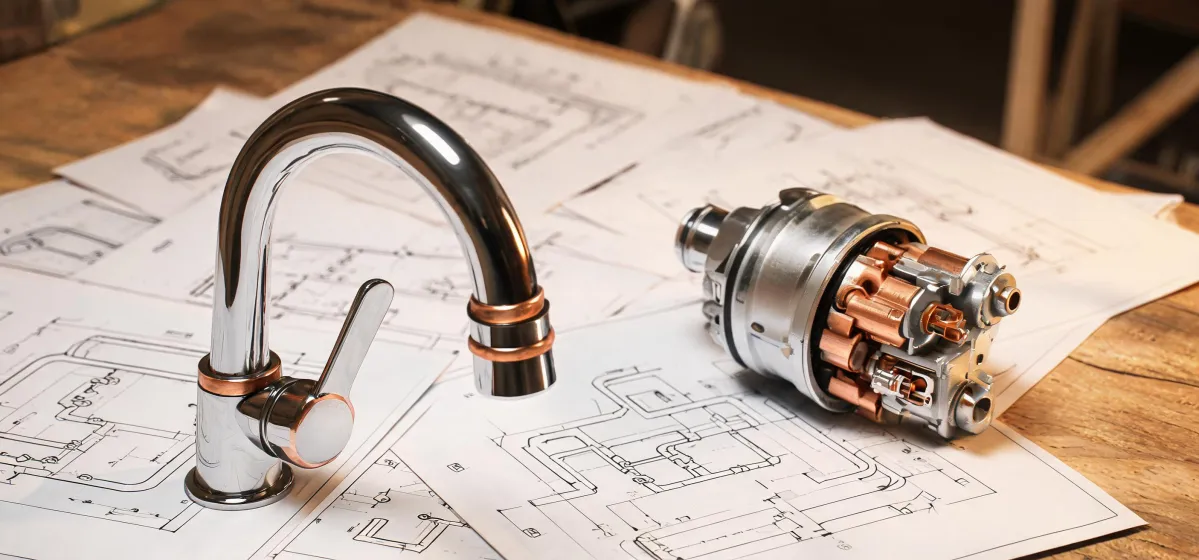
On a Tuesday morning in March 2024, our facilities manager forwarded me an email with the subject line "Bathroom Sink Leak—Again." The leak itself was minor. The line our CEO added at the bottom was not: "While we're in there, let's finally deal with the break room and the visitor bathroom."
That's how I ended up coordinating a renovation across two bathrooms and a break room, with a working budget of about $60,000 and a hard deadline of mid-June—right before the summer intern class arrived. I'm the office administrator for a 180-person company. I manage all facilities ordering, roughly $280,000 a year across 11 vendors, and I report to both operations and finance. I know how to buy things. I did not know how to spec a commercial faucet. (I do now, sort of.)
Why the lowest full-service quote made me nervous
My first call went to a facilities company we'd used before for small jobs. They described themselves as a one-stop shop: demolition, plumbing, tile, finish work, the whole thing. Their quote came back at $41,000—about $19,000 under what I'd penciled into the budget. I should have been thrilled. Instead, I kept rereading the scope document, which was five lines long.
No dimensions. No faucet models. No drain locations. When I asked follow-up questions, the answers were vague: "standard fixtures," "we'll match the existing layout." Note to self: "standard" is a word that hides a lot of decisions.
I asked our tile contractor—a guy we've used at the warehouse for years—to look at the drawing. He spent maybe four minutes with it. "The under-sink cutout doesn't match any faucet you'd actually buy," he said. "And the drain is behind the vanity wall. This isn't a plan, it's a wish list."
He suggested something I hadn't considered: source the faucets directly from an authorized dealer instead of letting a general contractor mark up whatever they could find at the supply house that week.
The specialist who said "we don't do that"
The dealer he pointed me to handled GROHE products. Their rep showed up with a case of samples and a clipboard of questions I hadn't thought to ask—water pressure, hot water source, how the vanity was joined, who would use each sink, and whether we wanted thermostatic control anywhere. For the visitor bathroom, we didn't. For the break room, where 40 people fill water bottles every single day, the answer was more complicated.
Here's the part that stuck with me. In the first meeting, the rep said: "We do water and fixtures. We don't do tile trim—you'll want a Schluter-certified installer for the shower niche. And we don't touch HVAC."
I'll be honest: my first reaction was irritation. I had six weeks and a spreadsheet. I wanted one throat to choke, as my old operations director used to say. But the more I thought about it, the more that boundary felt like a feature rather than a limitation.
We'd already had the HVAC conversation—more on that below—and the vendor who promised everything had already failed to answer basic questions about our last small job. The specialist wasn't telling me they were weak. They were telling me where their work ended, which meant I could see exactly where someone else's responsibility began.
The details that decided the project
We ended up with two different fixtures for two different jobs. Employee break room: a grohe pull down faucet, the kind with a spray head that pulls out on a hose. Forty people filling bottles and rinsing mugs beats up a fixed spout; the pull-down head lets someone fill a 32-ounce bottle without angling it under a sad little stream. It has held up well so far—about eleven months of daily use at this point.
Visitor coffee bar: a grohe gold kitchen faucet. That one was the CEO's call. She wanted the catering area to feel like a hotel lobby, and I get it—first impressions do work that no slide deck can. The dealer flagged two practical things before we ordered. Gold finishes need non-abrasive cleaners (no Scotch-Brite pads, ever), and in a heavy coffee-and-grease environment, the finish will dull faster than people expect. Their suggestion was to put it at the visitor bar rather than the main break room, where it would face three coffee runs a day and a dishwasher vent. Sensible advice, and it's why the thing still looks sharp.
Specs mattered more than style, honestly. The dealer supplied a written cut sheet with the exact hole diameter, deck thickness range, and supply line requirements. Our tile contractor built the shower niche with Schluter trim profiles, which did what trim is supposed to do—clean edges, no cracked grout lines a year later. Two trades, two scopes, zero finger-pointing when something went slightly off. (And something always goes slightly off.)
Install day gave us one hiccup: the break room shutoff valve was seized, and the dealer's installer wouldn't touch it because it sat behind a panel our GC was responsible for. Ten minutes of phone calls sorted it out. When scopes are clear, hiccups stay small.
Small side note: my son asked me to order him a pair of high top Converse for school that same week. I caught myself reading the return policy like it was a vendor contract. Old habits.)
The HVAC question nobody could answer
Partway through the renovation, the break room window started turning into a greenhouse every afternoon. Our CEO asked the obvious question: who makes the best heating and air conditioning units?
I spent about two weeks on that one. The short answer is that nobody can give you a universal "best" without knowing the building, the load, the maintenance contract, and the budget. Every company I called said they were the best. That's not useful information.
The FTC requires advertisers to back up objective claims (ftc.gov), and I borrowed that standard for vendor meetings: show me comparable installations. We ended up with a regional company that had done three buildings similar to ours—same age, same window wall, same occupancy pattern. I'm not going to claim they're the best HVAC company in the region. What I can say is that their proposal matched our actual conditions instead of a sales brochure.
The specialist mindset showed up again. One company told me flat out: "We're strong on retrofits in older buildings. If you ever build new, talk to someone else." They didn't have the vibe of desperation that usually makes me suspicious. They just drew a line around their work.
How it ended, and what I'd do differently
The project closed in mid-June 2024 at $58,400—under budget, which almost never happens in facilities work. No punch-list item sat open longer than two weeks. The pull-down faucet has needed one cartridge replacement in eleven months, covered under warranty, and the gold faucet at the visitor bar still gets comments from clients (usually "is that real gold?"—no, but it's convincing).
The invoice comparison mattered more than I expected. When the full-service company sent a revised quote, it was one line: "Additional plumbing labor—TBD." Finance rejected it on the spot. No PO number, no breakdown. The dealer's invoice, by contrast, listed model numbers, quantities, and unit prices, and matched our PO to the cent. That difference alone told me which vendor to keep.
It took me two office renovation projects and roughly 40 purchase orders to figure out that the vendor who tells you what they don't do is usually the one who does their own work well. That sounds obvious written down. It wasn't obvious when I was staring at a $41,000 quote and a six-week calendar.
I'd rather work with a specialist who knows their limits than a generalist who overpromises. A few things worth passing along if you're in a similar spot:
- Ask every full-service vendor for a written scope with dimensions and model numbers. If they can't produce one before the contract, they won't produce one after.
- For fixtures, get the cut sheet before the cabinets are ordered. A faucet that doesn't fit the hole is a $2,000 mistake nobody catches until install day.
- When someone says "we do everything," ask for two recent jobs where they actually did everything. Then call those clients.
This all reflects prices and product availability as of late 2024 and early 2025. Fixture pricing moves, and the HVAC rebate landscape has probably changed since we ran the numbers, so verify current rates before you budget anything.
My sample size is one mid-size office renovation with one dealer relationship, so take the specifics with that grain of salt. If you're outfitting a large commercial property or a residential build, the trade coordination probably looks different—bigger GCs, more formal submittals, more people in the room. But the boundary principle tends to travel. The best vendor relationships I've had, across faucets, tile, and HVAC, all started the same way: someone told me what they were good at, and what they weren't.

Stefan Petrescu
Stefan Petrescu is a building climate-systems analyst specializing in air-conditioning equipment, heat pumps, ventilation units, ductwork, controls, boilers, fireplaces, stoves, and flue components. He uses ANSI/ASHRAE Standard 62.1-2025 ventilation criteria while comparing outdoor-air rate, airflow, static pressure, heating and cooling capacity, part-load efficiency, sound level, filtration, condensate control, combustion-air provision, and clearances. His application guides help mechanical engineers, installers, and owners size systems, verify interfaces, and balance comfort, indoor air quality, energy use, and serviceability.